Agrohub has conducted its first study of income levels and the functional structure of commercial departments in agribusiness. The analysis covered three key areas: sales, third-party procurement of grain and oilseeds, and commercial logistics. Six agricultural companies with a combined land bank of 1.6 million hectares participated in the study. The analysis is based on data as of October 2025.
Grain and oilseed sales show the highest income levels
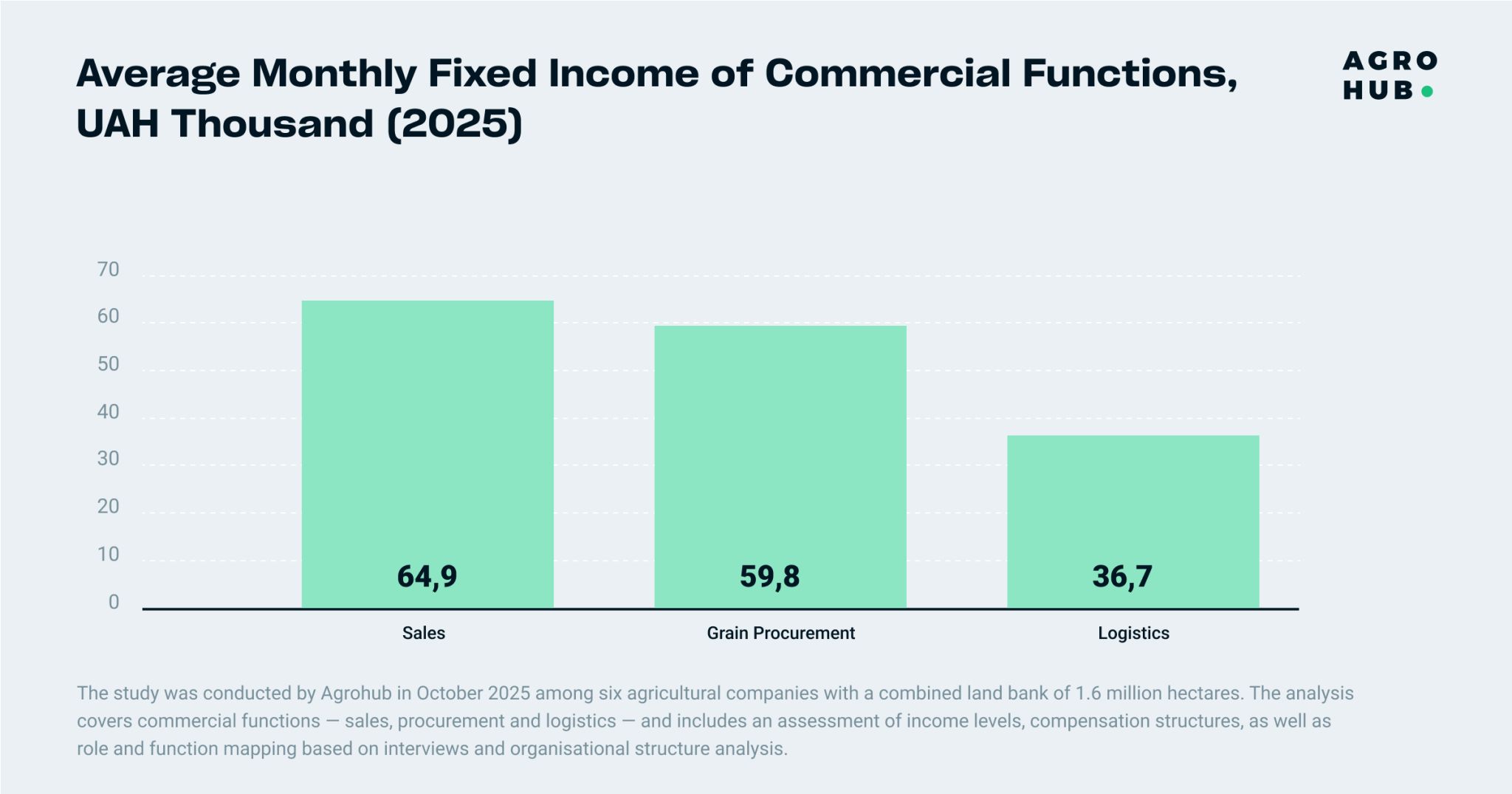
The median fixed monthly income in sales is UAH 64.9 thousand. In grain procurement, the figure is UAH 59.8 thousand, while in logistics it is UAH 36.7 thousand.
Among sales managers and specialists, the highest incomes are recorded among those working with grain and oilseeds. They are followed by sugar, livestock and other business areas in terms of compensation.
For most commercial functions, fixed salary remains the primary compensation model. Sales commissions based on volumes are less common and used only to a limited extent. Procurement is an exception, where variable compensation is applied more frequently, although companies use different approaches to its calculation. Annual bonuses are standard practice in sales and logistics.
Sales, procurement and logistics: how commercial functions are structured in agribusiness
Sales teams in agricultural companies operate through two main channels — exports and the domestic market. Export transactions are conducted, among others, on CPT, DAP and FOB terms. The organisational structure of these departments is generally similar: the front office is responsible for client relationships and closing deals, while the back office, or execution team, handles contract administration and documentation. This model separates the commercial function into client relationship development and operational support of transactions. Some companies divide execution teams by contract type, but a more universal model is becoming increasingly common, with employees handling different tasks depending on business needs.
Third-party grain procurement is the most dynamic segment among commercial functions. Companies are expanding these teams to ensure utilisation of grain elevators and port infrastructure. At the same time, approaches to employee motivation in this area are not yet standardised: companies are testing different combinations of fixed and variable compensation, as well as different bonus mechanisms.
Commercial logistics covers rail, road and sea freight, as well as customs clearance and certification. The highest incomes are recorded in sea logistics, followed by rail and road logistics. At the same time, rail logistics operates on a larger scale and employs more specialists, which affects the distribution of roles and workloads within teams.
“We see that sales and logistics are already operating according to fairly standardised models aligned with companies’ business approaches. At the same time, grain procurement is a rapidly growing function where companies are still searching for the optimal motivation models. Another important trend is the demand for versatile specialists who can work across different types of tasks — this is becoming an increasingly important factor in team efficiency,” said Dmytro Lyebyedyev, Head of Agrohub HR360 Benchmarking.
The study was conducted by Agrohub in October 2025 among six agricultural companies with a combined land bank of 1.6 million hectares. The analysis covers commercial functions — sales, procurement and logistics — and includes an assessment of income levels, compensation structures, as well as role and function mapping based on interviews and analysis of organisational structures.