Staff shortages in Ukraine’s agricultural sector have become a long-term feature of the market that companies will have to manage for years to come. This is the conclusion reached by Agrohub analysts based on the results of a labour market study in the agricultural sector for the first half of 2026. The study involved 16 agricultural holdings with a combined land bank of 2.2 million hectares, representing crop production, livestock farming and grain elevators.
Hiring is becoming more difficult: critical areas and the shift towards new workforce practices
The most severe staff shortages in Ukraine’s agricultural sector during the first half of this year were recorded among tractor operators, drivers, engineers and grain elevator workers. For these positions, companies most frequently report significant, substantial or critical staffing shortages.
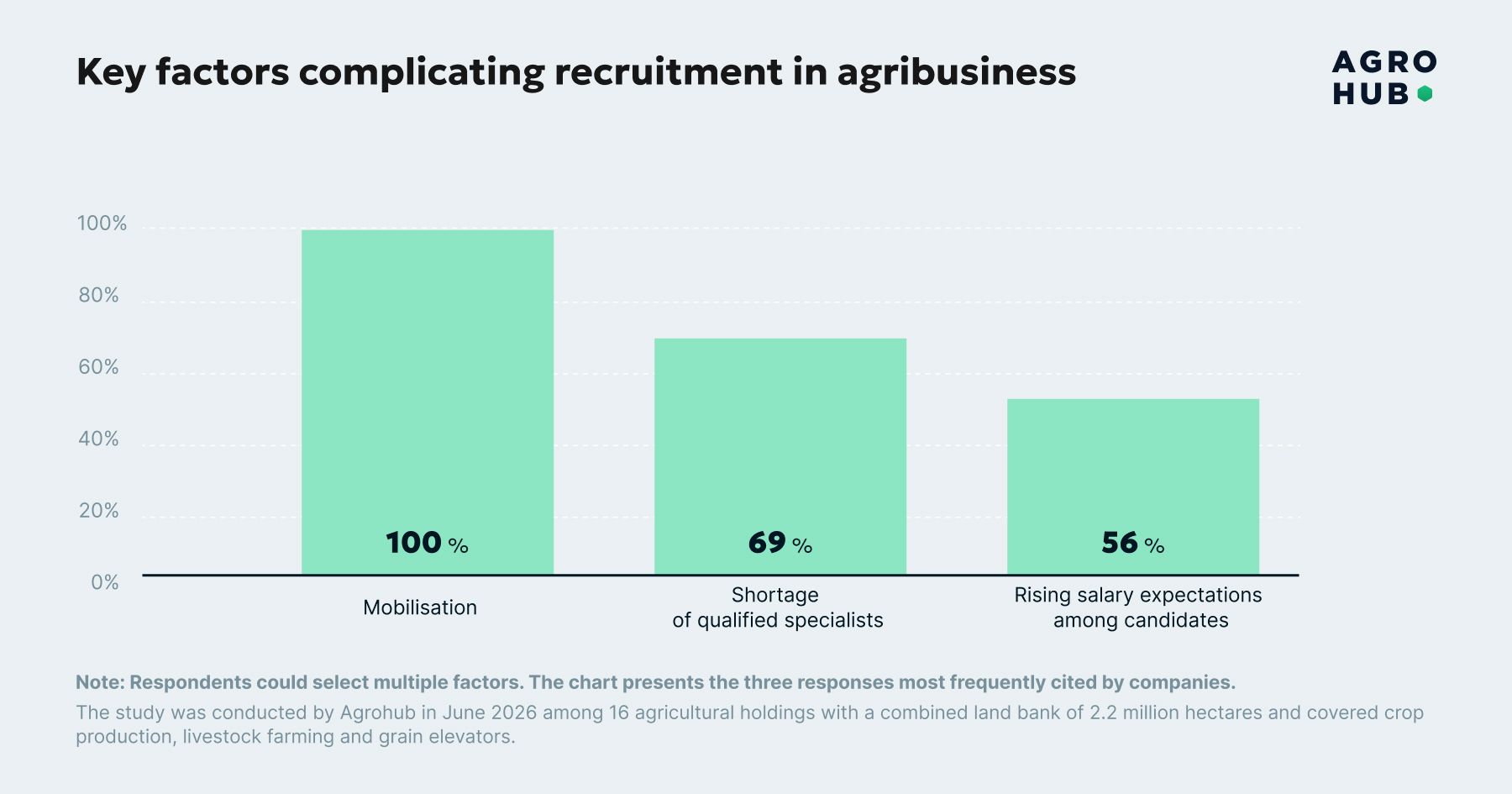
Among the main factors complicating recruitment, Ukrainian agricultural companies cite mobilisation (reported by all study participants), a shortage of qualified specialists (69%) and rising salary expectations among candidates (56%). Population migration and competition between employers were also among the key factors. Compared with last year, most companies say that hiring has become more difficult.
At the same time, staff shortages are absent or moderate in agronomy, land management and some service functions.
In response to labour shortages, agricultural businesses are systematically expanding their talent pools. Companies are increasingly recruiting employees from other regions of Ukraine, people aged 50+ and of retirement age, as well as women for roles that were previously considered male-dominated. Each of these approaches is used by 66% of the surveyed holdings. At the same time, companies note that new hires require internal retraining, so businesses are also investing in reskilling and process automation to reduce their dependence on hard-to-fill positions. The practice of recruiting foreign workers remains isolated and is still rarely used.
Compensation dynamics: 81% of agricultural companies have already revised salaries and pay rates
As of June 2026, actual income growth in the agricultural sector amounted to 10–20%. Salaries were revised most actively for categories facing the greatest staff shortages — agronomists, engineers, tractor operators and drivers. To retain tractor operators and drivers, holdings focused on increasing piece rates and the variable component of compensation rather than fixed salaries.
The market exceeded its own expectations from December, when most companies — among the 83% planning salary revisions — had anticipated a more modest increase of 10–15%.
The depreciation of the hryvnia partially reduced the effect of nominal income growth. Since the beginning of the year, the hryvnia has depreciated by approximately 6% — from UAH 42.35 to UAH 44.9 per US dollar. As of June, real employee income growth in US dollar terms is estimated at 4–9%, despite nominal increases of 10–20%. This means that companies increased personnel costs while maintaining employees’ purchasing power only moderately above the level needed to offset exchange-rate losses.
Most decisions on income revisions were made in the first quarter of 2026, mainly effective from 1 March and 1 April, as part of the annual budgeting cycle. Plans for the second half of the year are more restrained: 40% of companies are currently preparing additional compensation reviews.
“Companies delivered on their plans for the first half of the year and increased employee incomes, yet filling a vacancy today often costs more than retaining an existing specialist. At the same time, we see that financial incentives are reaching their limits as a standalone tool — an endless ‘salary race’ cannot overcome the physical shortage of people in the labour market. Forecasts for the second half of the year indicate that the market is moving towards more restrained and targeted financial adjustments, while shifting its focus towards structural changes: process automation, the development of internal training, expansion of traditional recruitment pools and a review of work organisation models. These are the solutions that will determine employers’ competitiveness in the coming years,” comments Dmytro Lyebyedyev, Head of HR360 at Agrohub.
The study was conducted by Agrohub in June 2026 among 16 agricultural holdings with a combined land bank of 2.2 million hectares and covered crop production, livestock farming and grain elevators. The study follows up on the December survey of companies’ plans for 2026. If you are an agricultural producer and would like to participate in the study and receive the full results, please contact Agrohub at dl@agrohub.org.