The article was published on Latifundist https://latifundist.com/blog/read/3171-rekordna-kukurudza-po-10-t-ga-a-marzhi-majzhe-nemaye-yak-ukrayini-peremogti-braziliyu-ta-argentinu-u-2026-rotsi
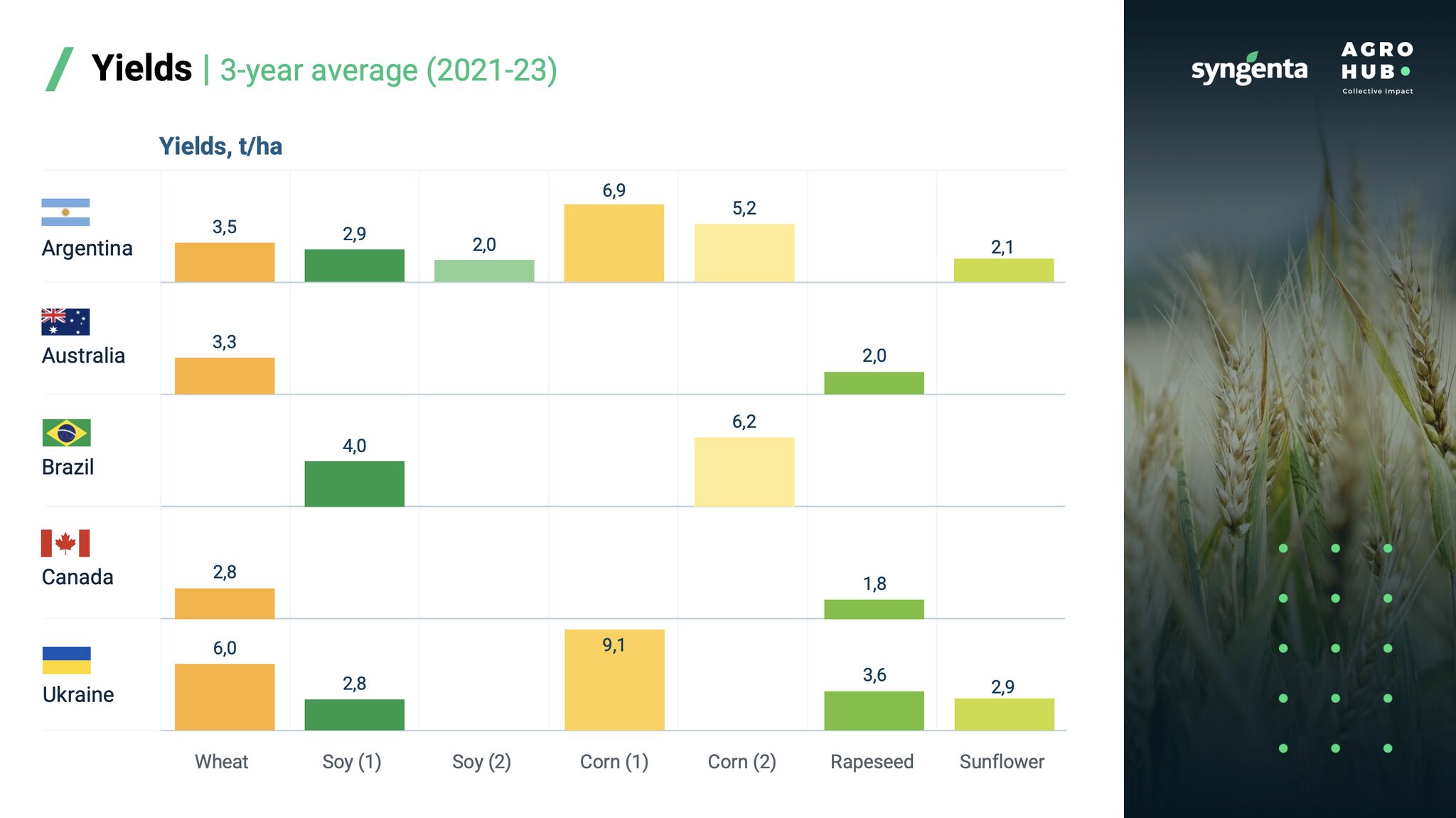
Ukraine ranks among the world leaders in corn and sunflower yields, yet at the same time operates with some of the highest costs per hectare. This contrast is the key challenge for the coming seasons: we know how to produce high yields, but we still need to learn how to generate stable profits.
Oksana Bobrova, Head of Benchmarking at Agrohub, shared the key findings of a global agricultural production efficiency study conducted by Agrohub in partnership with Syngenta. The data, collected from 24 companies across five major agricultural countries — Ukraine, Argentina, Brazil, Canada and Australia — with a combined land bank of more than 3.5 million hectares, show where field economics are underperforming and how agricultural producers can improve the resilience of profitability as early as this year.
Where Ukraine is strong: soils, climate and field potential
Ukraine’s agricultural potential rests on three main pillars: its chernozem soils, a relatively balanced climate, and the experience of large-scale producers. Even with the climate fluctuations of recent years — droughts in the south and heavy rainfall in the west — on average, Ukraine still has better conditions than some of its competitors.
This is why Ukraine ranks among the leaders in corn and sunflower yields. The potential is there — the question is how to convert it into margin.
The numbers that make you look closely at the economics
The 2023 season exposed a paradox. Corn in Ukraine delivered an adjusted yield of around 10.1 t/ha, while the break-even point stood at 9.6 t/ha. In Brazil, yields were lower at around 7.6 t/ha, but the break-even threshold was also much lower at 6.1 t/ha; in Argentina, the figures were 5.8 t/ha and 4.8 t/ha, respectively.
For soybeans, Ukraine achieved around 2.9 t/ha, with a break-even point of 2.0 t/ha, compared with approximately 3.8 t/ha and 2.6 t/ha in Brazil.
Wheat is Ukraine’s weak point: an average yield of 6.7 t/ha against a break-even point of 8.1 t/ha, meaning that most producers were operating at a loss. Sunflower (around 3.0 t/ha vs 2.8 t/ha) and rapeseed (around 3.7 t/ha vs 3.3 t/ha) looked considerably healthier.
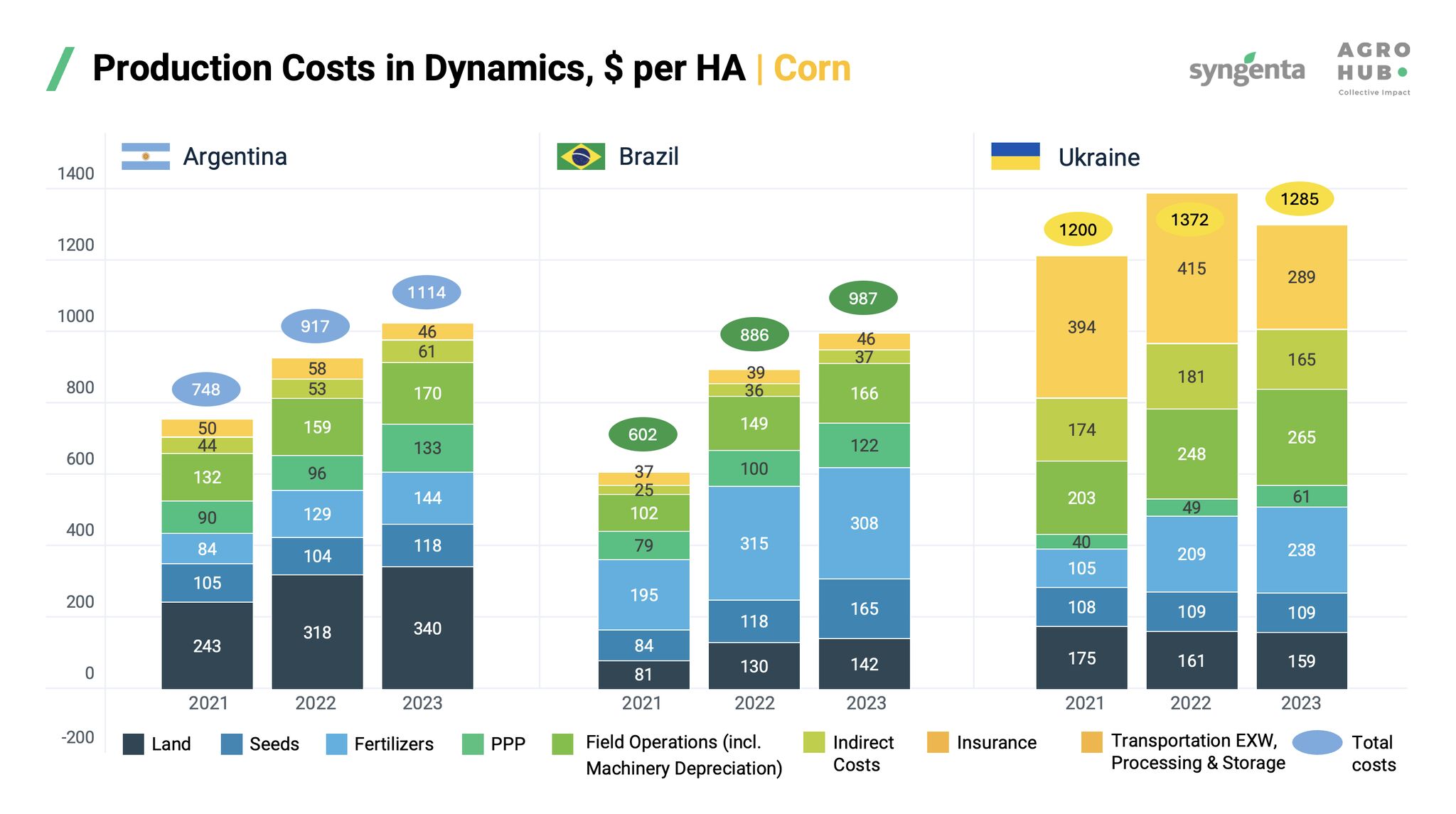
Why is this happening? One of the answers lies in the cost structure. Using corn in 2023 as an example, costs in Ukraine amounted to approximately $1,285/ha — the highest among the countries analysed and significantly above the approximately $998/ha recorded in Brazil and Argentina.
The situation is better for sunflower: around $948/ha in Ukraine compared with approximately $967/ha in Argentina. Yet the overall trend is clear: Ukraine often achieves high yields through expensive operations and inputs, particularly fertilisers and field operations.
Logistics and storage: the ‘invisible’ costs eroding margins
Logistics has shifted from an operational routine to a strategic factor affecting profitability. The cost of transportation from fields to elevators, unpredictable routes and queues during peak periods all increase costs and risks.
Some companies are responding with flexible solutions, from grain bags to digital field-to-storage planning, but there is still no systemic competitive advantage. The potential for efficiency gains here is no smaller than in the fields themselves.
It is also worth noting that third-party carriers account for up to 85% of the harvested crop transported in Ukraine.
Where are the main areas for improvement?
1. Control the economics of every hectare. Break down production costs in detail, going beyond broad categories such as “inputs + operations” to create break-even maps for each field and identify risk zones. Where the break-even point is dangerously close to the planned yield, a different cost and technology approach — as well as a different level of risk coverage — is required.
2. Pay close attention to fertiliser efficiency. For high-cost crops and fields, introduce balanced crop nutrition and variable-rate application. Base rates on nutrient removal and actual soil reserves rather than average assumptions. Increase the share of localised application for crops where early-stage nutrition is critical. Saving 5–10% on fertiliser costs can often add 1–2 percentage points to margin without reducing yields.
3. Standardise field operations as a service. Some of the most expensive elements are fuel use, machinery passes and downtime. Introduce real-time monitoring of field operations. The cost of an operator error or an unnecessary combine pass on a peak harvesting day can amount to tens of dollars per hectare, multiplied across thousands of hectares.
4. Invest selectively where ROI is fastest. In Ukraine, this includes soil moisture monitoring, yield maps to identify field “blind spots”, and targeted irrigation in areas with predictable drought risks.
Wheat as a test of management maturity
If one crop can serve as an indicator of management maturity, it is winter wheat. It is one of Ukraine’s most widely grown crops, yet had the weakest economics in the 2023 season.
Meaningful progress here can only be achieved through a comprehensive approach: from adjusting varietal strategy and sowing dates to plant density, nitrogen placement, more precise crop protection and sales contracting.
Wheat is one of the best testing grounds for cost discipline because it quickly exposes any mismatch between production technology and economics.
Conclusion
Markets are volatile, logistics are uncertain and risks remain high. Yet these are precisely the conditions in which competitive advantages that last longer than a single season are built. Ukraine has something that cannot simply be purchased: land and production potential. Its competitors have something that can be adopted relatively quickly: strong processes and cost discipline. When consistent management practices are added to Ukraine’s strength in crop yields, the cost gap narrows and margins become more resilient.